Driving Range Practice Plan: Stop Raking Balls
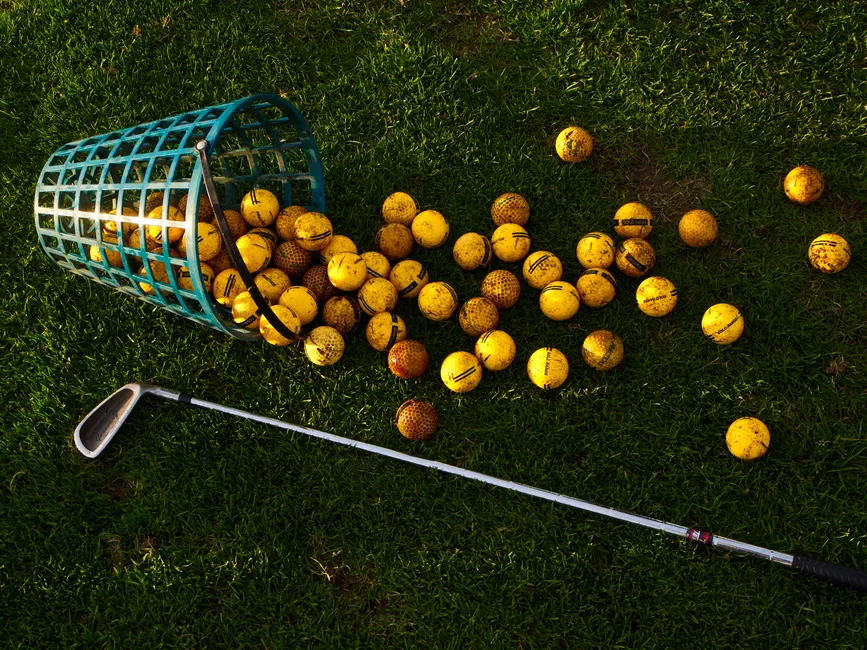
Stop treating the bucket as a countdown
A productive driving-range plan moves through warm-up, technical calibration, target practice, and random course simulation. It uses fewer careless shots and more routines. A practical session might devote the first quarter to warming up, the second to one drill, the third to targets, and the final quarter to simulated holes.
Before swinging, confirm every person is clear of the full club arc and likely ball path, check the bay, dividers, and mat, and never step beyond the designated hitting line. Adjust duration and volume for physical condition. Stop for pain, dizziness, unusual symptoms, or fatigue that changes balance or control.
Warm up from small to full
Begin with comfortable movement and half-wedge shots. Progress through short irons before longer clubs. Use enough rest between swings to maintain grip and balance.
Use dividers and mats as the facility directs, and position alignment aids where the club cannot strike them. Take enough space and time between shots to rebuild a secure grip and balanced setup.
Calibrate one technical priority
Choose one issue supported by evidence: face contact, start direction, curve, low point, or tempo. Use one drill for three groups of five balls. Record a simple success measure after each group.
For example, use tempo practice and count balanced finishes, or work the slice diagnostic and count balls starting through a window. Change the cue only between groups.
Shift from mechanics to targets
Remove or reduce the drill and choose a fairway-width target. Hit one club for three shots, then change target or club. Go through a full routine behind each ball.
Score the intended start window, curve, contact, and whether the result would be playable. A shot can be useful without landing beside a range flag when it matches the decision you practiced.
Simulate holes
Imagine a course hole with boundaries and hazards. Hit a tee shot, then choose the next club based on the result. If the first ball would be in trouble, play a recovery shot. Finish with an imagined wedge target.
Use one ball per decision and no immediate mulligan. Simulate three holes with different shapes. This trains club choice and emotional reset as well as motion.
Alternate block and random practice
In this plan, repeat one club briefly while learning a change, then vary clubs and targets to see whether you can reproduce it without immediate repetition. Use both: build the pattern, then make it survive a new target and club.
For a shorter session, preserve the same order while reducing the number of groups rather than rushing between them.
Finish with evidence
Hit three final shots to one realistic target using the course routine. Record how many were playable and the dominant miss. Use simple stat tracking to decide the next session rather than choosing whichever swing tip arrived most recently.
Stop when fatigue changes balance, grip security, or contact. End the session before control deteriorates. Persistent, recurring, or concerning symptoms require assessment by a qualified clinician; a qualified golf coach can review technique only after the immediate health concern is addressed.
Before every rehearsal or shot, confirm that nobody is inside the full clubhead arc or likely ball path. Confirm the landing area is clear, and never swing or hit while anyone is in range.
Stop immediately if force, rotation, or repetition causes pain, numbness, tingling, weakness, dizziness, or loss of control. Persistent, recurring, or concerning symptoms require assessment by a qualified clinician; a qualified golf coach can review technique only after the immediate health concern is addressed.