Golf Ball Position: A Practical Starting Guide
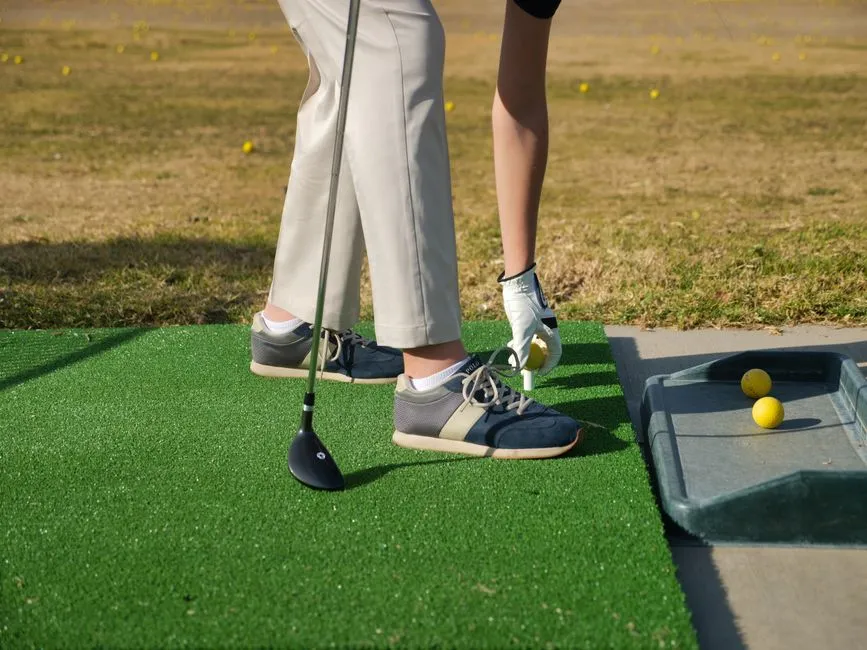
Ball position changes where the club meets the arc
Golf ball position is the ball's location forward or back in the stance and its distance from the body. A practical starting pattern places wedges and short irons near the middle, longer irons gradually forward, and driver near the lead heel for many stock shots. Exact position depends on swing, club, lie, and intended trajectory.
Use consistent references and change one factor at a time. “Somewhere under the logo on my shirt” is a memory, not a measurement.
Start from a centered short iron
With a short iron, place the ball around the middle of a comfortable stance. Build balanced posture and hit small shots. Look for centered face contact and turf contact beginning at or just beyond the ball for a normal fairway lie.
If contact is consistently behind the ball, do not move it backward endlessly. Low-point control, pressure movement, posture, and sequence can be involved. Use the fat-shot guide for diagnosis.
Move longer clubs forward gradually
As club length increases, many players widen the stance and position the ball modestly farther toward the lead foot. This gives the longer arc room and can support the desired launch. The change should be gradual, not a separate zip code for every club.
For driver from a tee, a forward ball position often helps contact occur later in the arc. Tee height, strike location, and individual delivery matter. Use face spray or another approved marker to track strike safely.
Keep distance from the body responsive
Ball position is also near or far. Longer clubs naturally place the ball farther away because of shaft length and lie. Let arms hang and maintain balance; do not reach simply to copy a floor marker.
Too close can crowd the handle and encourage heel contact. Too far can pull weight forward and encourage toe contact or loss of posture. Contact pattern supplies the clue.
Adjust for the lie and shot
A ball above or below the feet, in rough, on a slope, or requiring a low or high trajectory may call for a different position and stance. Practice specialty shots only in safe facility conditions with a qualified coach. Stop if an uneven lie or repeated ground contact causes wrist, hand, knee, hip, or back pain, and obtain appropriate clinical guidance before resuming.
Moving the ball back can lower launch and change face-path relationships; moving it forward can raise launch and alter start direction. Neither is a free trajectory button. Observe curve and strike.
Use a three-line station
Place one stick along the target line, one safely along the toes, and a perpendicular reference outside the swing area to mark ball position. Before every shot, confirm every person is clear of the full club arc and likely ball path. Hit three shots, step away, and rebuild. Never place a stick where the club could strike it or drive it into the ground near your body.
Check alignment after every ball-position change because the shoulders often rotate while the feet shuffle.
Build a personal map
Record comfortable positions for wedge, mid-iron, hybrid or fairway wood, and driver. Add strike and flight, not merely the spot. Recheck periodically because posture and technique evolve.
Keep the reference simple enough to rebuild, then change it only when strike, flight, lie, or intended trajectory provides a clear reason.
Before every rehearsal or shot, confirm that nobody is inside the full clubhead arc or likely ball path. Confirm the landing area is clear, and never swing or hit while anyone is in range.
Stop immediately if force, rotation, or repetition causes pain, numbness, tingling, weakness, dizziness, or loss of control. Persistent, recurring, or concerning symptoms require assessment by a qualified clinician; a qualified golf coach can review technique only after the immediate health concern is addressed.